
Among the keenly watched contests are those involving former Uttar Pradesh chief minister Akhilesh Yadav (Kannauj, UP) and Union ministers Giriraj Singh (Begusarai, Bihar), Nityanand Rai (Ujiarpur, Bihar) and Raosaheb Danve (Jalna, Maharashtra).
State capital Lucknow shuddered at 0.7 degrees Celsius, while Bahraich recorded a low of 0.2 degrees Celsius.

The cold wave sweeping most parts of north India intensified and Ambala recorded a low of 3.6° C, down three degrees, while Karnal was also colder by three degrees at 4.1° C.

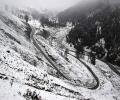
The snowfall has prompted authorities to shut down the Jammu-Srinagar National Highway and schools and colleges are also shut.
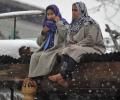
Cold wave and fog persists across North India disrupting traffic and normal life.

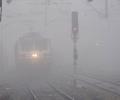
Dense to very dense fog engulfed the Indo-Gangetic plains, including Delhi, for the second morning on the trot on Tuesday, lowering visibility to 50 metres in the city and affecting road traffic and train movement.

This is the first major snowfall in Kashmir this winter, which was largely dry so far.

The Northern Railways said it has cancelled around 17 trains and diverted around 12 others, while traffic has been suspended at four locations due to waterlogging.

There was some respite in cold conditions in Kashmir as the mercury went up by several degrees at most places after four days of virtual free fall.

The snowfall has set in cold wave like conditions in the Valley as electricity supply in many areas was snapped as a precautionary measure, they said, adding that dewatering pumps were made operational in the city to avoid waterlogging.
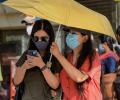
A tormenting heatwave swept through North India on Sunday with the mercury crossing 49 degrees Celsius in pockets of Delhi, while the weather office forecast some relief Monday onwards.

Delhi recorded a cold wave for the second consecutive day on Friday, with the minimum temperature at Ayanagar in southwest Delhi plunging to a numbing 1.8 degrees Celsius.

A high-intensity earthquake struck the Hindukush region in Afghanistan on Monday, tremors of which were felt in several parts of North India including Jammu and Kashmir and Delhi.
The weatherman has forecast widespread downpour in the Valley on Saturday and scattered precipitation on Sunday.

Most places in Kashmir continued to reel under intense cold with the night temperature staying below the freezing point, while Kargil town in Ladakh region registered the season's coldest night at minus 9.2 degrees Celsius.

Intense cold wave gripped Kashmir, with Kargil becoming the coldest place this winter.

Cold wave conditions continued unabated in Kashmir Valley owing to the dry weather even as the weatherman predicted some respite next week with the possibility of isolated rains or snowfall.

Leh in Ladakh region recorded the lowest temperature this winter as mercury plummeted to minus 17.1 degree Celsius on Tuesday night, a meteorological department official said.
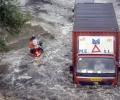
A record 119.3 mm rainfall pounded Delhi under the impact of cyclonic storm Tauktae and a western disturbance in 24 hours ending 8:30 am on Thursday, breaking all the previous records for May, the IMD said on Thursday.

Srinagar, the summer capital of the state, recorded a low of -4.2C, slightly up from the previous night's -4.9C.
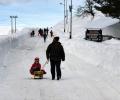
Landslides have occurred near Ramban and Battery Cheshma which have forced the closure of the highway.

Cold wave conditions remained unabated as the night temperature across Kashmir continued to stay below the freezing point with forecasts for dry spell.

The sky turned cloudy around 4:30pm and gusty winds swept the national capital.

The city also recorded a maximum temperature of 23.8 degrees Celsius, 16 notches below normal and the lowest in the month of May since 1951, the IMD said.
Due to heavy fog on Saturday morning, four flights have been diverted from Delhi airport.
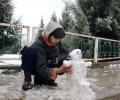
Kashmir Valley on Thursday experienced fresh snowfall with most places, especially the plains, witnessing the first snow of the season, breaking the prolonged dry spell at the fag end of 'Chillai-Kalan', the 40-day period of harshest winter. While the snowfall was mild and brief, it nonetheless brought much joy to the locals.

According to officials, the Ganga was flowing at 463.20 metres following which water filled up in Sangam Ghat, Ramkund, Dhaneshwar Ghat and Fuladi Ghat. There was also a tremendous jump in the water level of the Ganga after 2,000-3,000 cusecs of water was released from the dam of the GVK hydroelectric project built on the Alaknanda river.

Srinagar recorded a low of minus 3.2 degrees Celsius, an increase of two degrees from the previous night's minus 5.2 degrees Celsius, a spokesman for the MET department said in Srinagar.

A Korean couple and a retired Army Major General were among 310 people rescued by Chandigarh-based 12 Wing of the Indian Air Force, which has been conducting non-stop sorties during the past three days to evacuate people from flooded areas of Srinagar.
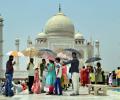
The experts said that climate change is not only raising temperatures and making India's heatwaves hotter, but also changing weather patterns that further drive dangerous weather extremes.

The Amarnath pilgrimage resumed on Monday after remaining suspended for three days following flash floods that claimed 15 lives, while the Jammu and Kashmir administration said it would get a clear picture by Tuesday about the damage.

The 40-day period marks the harshest phase of the winter in the Kashmir valley.

The minimum temperature settled at 2.6 degree Celsius at the Safdarjung observatory, four notches below the season's average, and humidity was 100 per cent. The visibility recorded by the Safdarjung and Palam observatories stood at zero metres at 8.30 am. It was recorded at 100 metres at Safdarjung and zero at Palam at 5.30 am.
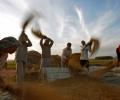
'There is no mechanism to understand how things would evolve'.
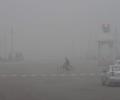
It was another chilly morning in the national capital as icy winds swept the city while early morning fog disrupted rail operations, delaying 52 trains.
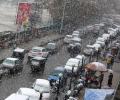
The highway was closed on Saturday due to heavy snowfall and landslides.
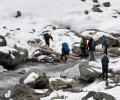
Pahalgam and Gulmarg were the only recorded places in the Valley where the mercury was below the freezing point.

Fresh snowfall was recorded in the higher reaches of Kashmir overnight while the plains received rains, even as the mercury stayed above the freezing point at most places.
The cold conditions returned in Kashmir division as the night temperature in most places, including Leh, plunged further below the freezing point followed with clear skies and unusual sunny days.
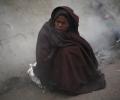
The minimum temperature plunged to 4.2 degrees Celsius in New Delhi on Monday, the coldest December 22 in the last five years and also the lowest this season, even as a thick blanket of fog disrupted normal life in the city and hit flight and train operations.
 © 2026 Rediff.com - Advertise with us - Disclaimer - Privacy Policy - Sitemap - Feedback - About us - Terms of use - Grievances